Nobody wants to hear, “You might need a new AC.”
Usually, that conversation starts when your house is already hot, the system is running nonstop, and you are trying to decide whether one more repair is worth it. The technician gives you a repair estimate. Then the bigger question hits:
Should you fix the air conditioner you already have, or is it time to replace it?
That is not always an easy call.
A small repair on a newer system can make total sense. But putting money into an older air conditioner that keeps breaking down can feel like paying for the same problem over and over again. At some point, the question is not just “Can this AC be repaired?” The better question is, “Will this repair actually solve the problem long enough to be worth it?”
This guide will help you think through that decision clearly. We will look at system age, repair cost, repair history, cooling performance, energy bills, humidity problems, refrigerant issues, ductwork, and comfort. The goal is simple: help you make a smart decision before spending money on the wrong option.

Look at What the Repair Actually Solves
Before deciding between AC repair and replacement, look beyond the repair price. A cheap repair is not always a smart repair, and an expensive repair is not always the wrong choice. What matters is whether the repair will restore dependable cooling or only keep the system running a little longer.
If the problem is simple and the rest of the system is in good shape, repair often makes sense. Issues like a bad capacitor, clogged drain line, thermostat problem, dirty coil, or worn contactor can usually be fixed without replacing the entire air conditioner.
The decision gets harder when the repair involves a major part or the system already has a history of problems. Compressor issues, evaporator coil failures, refrigerant leaks, and repeated electrical repairs can be costly, especially on an older AC.
A good question to ask is: after this repair, will I trust this system to cool my home through the season? If the answer is yes, repair may be the right move. If the answer is no, replacement may be worth discussing.
How Old Is Your Air Conditioner?
Age is one of the first things to consider when deciding whether to repair or replace your air conditioner. An older AC is not automatically a bad system, but age can change how much sense a repair makes.
A newer system with one minor issue is usually a good repair candidate, especially if it has been maintained well and was cooling properly before the problem started. An older system with repeated repairs, weak cooling, high energy bills, humidity problems, or uneven temperatures deserves a closer look.
The goal is not to replace an AC just because it has been around for a while. The goal is to understand whether the system still has reliable life left. If it is older and starting to show multiple warning signs, replacement may be the better long-term choice.
When AC Repair Usually Makes Sense
Repair often makes sense when the problem is isolated and the system has been reliable overall.
You may be better off repairing your AC if:
- The system is still relatively newer
- The repair is minor
- The unit has not needed repeated service
- It still cools your home evenly
- Your energy bills are normal
- The system is still under warranty
- The repair cost is reasonable
- The technician finds no major underlying damage
For example, replacing a capacitor on a system that has otherwise been dependable is very different from replacing a compressor on an older unit that has had three service calls in two summers.
The first situation is normal equipment maintenance.
The second may be a warning that the system is reaching the end of its reliable life.
When AC Replacement Makes More Sense
Replacement becomes more reasonable when the repair does not solve the bigger problem.
You may want to consider replacing your AC if:
- The system is more than 10 years old
- Repairs are becoming frequent
- The same problem keeps coming back
- The repair involves a major component
- The AC runs constantly but still does not cool well
- Your home feels humid or uneven
- Energy bills keep increasing
- The system uses older refrigerant
- The outdoor unit is badly rusted or damaged
- The AC was never sized or installed correctly
This is where homeowners often get stuck. The system may still run, so replacement feels premature. But running is not the same as performing well.
If your air conditioner runs all day, struggles to cool, leaves the house sticky, and keeps needing service, you are not really saving money by keeping it. You are paying for repairs, higher energy use, and lower comfort at the same time.
The One-Repair vs. Pattern-of-Repairs Test
One repair after years of dependable service is usually not a major concern. If your AC has been working well and suddenly needs a minor fix, repair may be the practical choice.
The Repair Cost Test
Repair cost should be compared to the age and condition of the system. A minor repair on a newer AC usually makes sense. A major repair on an older, unreliable, or inefficient unit may not.
Do not look at the repair price alone. Ask whether the repair will restore dependable cooling or only keep the system running a little longer.
The Comfort Test
If your AC still runs but your home stays hot, humid, or unevenly cooled, the problem may be bigger than one worn part. Weak airflow, short cycling, constant running, and poor humidity control can point to sizing, ductwork, airflow, or aging equipment issues.
If a repair will not fix the comfort problem, replacement may be worth considering.
The Energy Bill Test
Rising energy bills can be a sign your AC is working harder than it should. Dirty coils, weak airflow, low refrigerant, duct leaks, short cycling, or aging parts can all reduce efficiency.
If repairs fix the immediate issue but the system still wastes energy every month, replacement may offer better long-term value.
The Major Component Test
Minor parts can fail without meaning the whole AC needs to be replaced. Major repairs are different.
Think carefully before approving costly repairs involving the compressor, evaporator coil, condenser coil, major refrigerant leaks, blower motor, or electrical controls. If the system is older and already unreliable, replacement may be the smarter long-term decision.
Do Not Ignore Refrigerant Issues
Refrigerant problems deserve special attention because they can affect both cooling performance and the long-term health of the system. If your AC is low on refrigerant, it usually means there is a leak. Refrigerant does not get used up like fuel. It moves through a sealed system, so low refrigerant is a sign that something needs to be found and repaired.
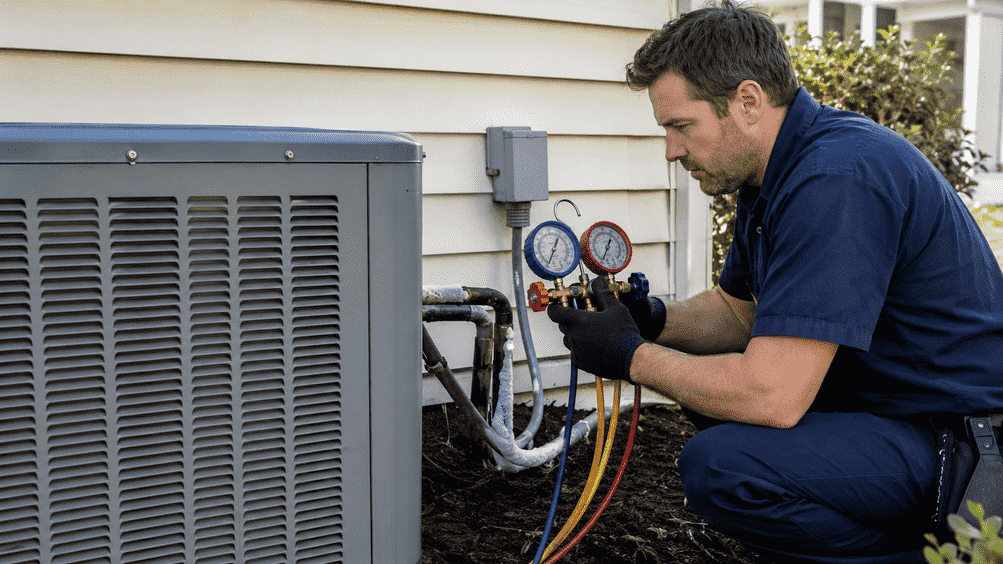
A refrigerant leak can cause warm air, frozen coils, longer run times, higher energy use, and extra strain on the compressor. If the system is older or the leak is difficult to access, the repair may become expensive enough to compare against replacement.
Refrigerant work is not a DIY repair. The system is sealed, pressurized, and requires the right tools and training. If your AC has a refrigerant leak, ask your technician how serious the leak is, whether it can be repaired, what condition the rest of the system is in, and whether repair or replacement makes more sense.
Proper Sizing Matters If You Replace
If replacement is on the table, do not assume the new AC should be the same size as the old one. The old system may have been too large, too small, or poorly matched to the home from the beginning.
AC size affects comfort. An oversized air conditioner may cool the home too quickly and shut off before it removes enough humidity. That can leave the house feeling cool but sticky. An undersized air conditioner may run nonstop and still struggle to keep up during hot weather.
The right replacement should be based on the home’s size, layout, insulation, ductwork, windows, airflow, and cooling needs. A new AC should not just replace the old equipment. It should solve the comfort problem, improve efficiency, and help the home cool more evenly.
Do Duct Problems Change the Decision?
Yes. Sometimes the air conditioner gets blamed for problems caused by the ductwork.
Leaky, undersized, damaged, or poorly designed ducts can make even a good AC struggle. If air is escaping into an attic, crawl space, or wall cavity, your system may run longer without making the home comfortable.
Common signs of duct or airflow problems include:
- One side of the house is always warmer
- Some vents barely blow air
- Rooms feel dusty
- The AC runs longer than expected
- The home feels humid
- The system is noisy
- Repairs have been made, but comfort has not improved
This is why AC replacement should not be based on the outdoor unit alone. The full system matters, including the ductwork, airflow, return vents, insulation, and equipment size.
Maintenance History Matters
A well-maintained AC is usually a better candidate for repair than a neglected one. If the system has been serviced regularly, has clean coils, proper airflow, and no major history of breakdowns, a repair may still be a smart choice.
A neglected system is different. If maintenance has been skipped for years, the AC may have hidden wear that makes future repairs more likely. Dirty filters, clogged coils, weak airflow, worn parts, and drainage problems can all make the system work harder than it should.
This is why maintenance history matters when deciding between AC repair and replacement. A 10-year-old system that has been cared for may still have useful life left. A 10-year-old system that has rarely been serviced may be much closer to failure, even if it still turns on.
Questions to Ask Before You Decide
Before choosing repair or replacement, ask your HVAC technician:
- What exactly failed?
- Is this a minor problem or a major component issue?
- Is the system still under warranty?
- Are there signs of other parts wearing out?
- Is the refrigerant charge correct?
- Is there a refrigerant leak?
- Is airflow within the proper range?
- Are the coils clean?
- Is the ductwork affecting performance?
- Is the system properly sized for the home?
- How long should this repair realistically last?
- Would you repair this system if it were in your own home?
That last question is useful because it moves the conversation from sales language to practical advice.
When Repair Is the Smart Move
Repair makes sense when the problem is clear, affordable, and the rest of the AC is still in good shape. If the system has been cooling well and only needs a simple fix, such as a capacitor, thermostat, clogged drain, or minor electrical repair, replacement may not be necessary.
A good repair should restore normal cooling and give you confidence in the system again. If it feels like you are only buying a little more time, replacement may be worth discussing.
When Replacement Is the Better Move
Replacement makes more sense when the AC is older, unreliable, inefficient, or needs a major repair. If the system keeps breaking down, runs constantly, leaves rooms uncomfortable, or causes rising energy bills, another repair may not solve the real problem.
The simple rule is this: repair is best when it fixes the issue. Replacement is better when repair only delays the next breakdown.
You should not have to guess whether your AC is worth repairing or replacing. Piedmont HVAC, Plumbing and Chimney can inspect your system, explain what is happening, and give you clear options based on the condition of your air conditioner.
If a repair makes sense, we will tell you. If replacement is the better long-term choice, we will explain why. Our goal is to help you make the right decision for your home without pressure.
Final Thoughts
Deciding whether to repair or replace your air conditioner comes down to the full picture. A newer system with a minor issue is usually worth repairing. An older system with frequent breakdowns, poor cooling, high energy bills, or major repair needs may be better replaced.
If your AC is giving you trouble, contact Piedmont HVAC, Plumbing and Chimney today. Our team can inspect your system, explain your options, and help you choose the best next step for your home.
Frequently Asked Questions
An AC repair cost may be too high if the system is older, out of warranty, and the repair involves a major part like the compressor, evaporator coil, or refrigerant leak. The repair should be compared to the age, condition, and reliability of the system.
Usually not for long. If your AC needs service every cooling season, the system may be losing reliability. Repeated repairs, weak cooling, high energy bills, and poor airflow are signs replacement may be the better long-term option.
You may still consider replacement if the AC runs constantly, cools unevenly, leaves the home humid, or costs too much to operate. An air conditioner can still turn on but no longer perform efficiently or comfortably.
A compressor repair may not be worth it on an older AC unit, especially if the system is out of warranty or has other issues. Since the compressor is one of the most expensive parts, replacement may offer better long-term value.
Yes. Leaky, damaged, undersized, or poorly designed ductwork can cause weak airflow, uneven cooling, hot rooms, and longer run times. A technician should check airflow and duct issues before recommending AC replacement.
Replacing your AC before a total breakdown can make sense if the system is old, unreliable, inefficient, or close to needing a major repair. Planning ahead can help you avoid emergency replacement during extreme heat.